
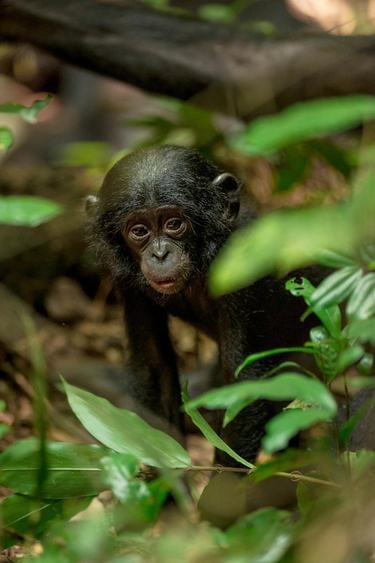
It’s 5am in the forests of Salonga National Park and a team of bonobo trackers mobilizes to head into the forest. Their goal? To find bonobos in their nests and, once found, follow these extraordinary primates and one throughout the day, without causing the animals stress or prompting them to flee.
For the past 18 months, the team of eight trackers has followed the same daily routine. Their gentle approach, based on patience and repetition, is beginning to pay off: They can now approach the bonobos at close range for extended periods, observe social interactions, and gather valuable data on individual behavior, including photos and video. Soon, the trackers hope to follow the bonobos from sunrise to sunset.
Getting to know bonobos
Bonobos, like chimpanzees, are humankind’s closest living relatives, sharing 98.7% of human DNA. They live in complex communities that, unlike other primates, are female-led and often divide into subgroups for certain jobs, such as searching for fruit during the dry season.
For scientists, the number of subgroups and the primates’ remote location make determining the number of individuals and their social composition a major challenge. But thanks to meticulous observation, the trackers in Salonga have identified a group and subgroups of individuals in the park, allowing for daily monitoring.
"When an entire family gets used to the presence of humans, it becomes easier to integrate other individuals into the [habituated] group,” says Elisabeth Bru, a primatologist working with the Bonobo Habituation Program, “Because bonobos imitate the behavior of their already accustomed peers."
Encouraging results
These advances in habituation pave the way for responsible tourism, focused on conservation and respect for the animals. Tourism infrastructure—lodges, restaurants, and offices—are currently under construction in the Salonga region. It’s another substantial step towards a future that helps the endangered bonobo population and the local communities.
Join the discussion